Mycelium Architecture:
Building a Sustainable Future


I.Introduction: Touching the Earth Through Design
A childhood in Delhi taught me that concrete doesn’t just harden beneath our feet—it calcifies in the lungs, in the air, in the pauses between breaths. The skyline grew taller, but the trees thinned. Pavements widened, yet shade became scarce. I didn’t have the language for it then, but I felt the shift viscerally: design wasn’t neutral. It decided who got to breathe easier and who didn’t.
Later, walking through London’s quieter streets, I found a different rhythm. Brick façades, moss between cobblestones, allotments carved into corners of old industrial land. Still, something felt absent. Despite the abundance, I sensed disconnection—spaces made to perform progress rather than nurture presence.
In both cities, the built environment whispered stories: of extraction, of ambition, of forgetting where the materials come from. Concrete, steel, glass—all extracted, processed, poured into forms that shape our waking lives. Architecture became a monument to control, and yet, the earth keeps pushing back—through cracks, through spores, through the quiet rebellion of a mushroom in a basement.
My work in branding and communications often brushes against these edges: how sustainability is packaged, how nature is positioned. But beyond strategy decks and ESG statements, there is a deeper question lingering—what might it mean to build with care, not just for humans, but for the mycelial networks beneath our feet?
As we confront the climate crisis, the answer may lie not in reinforcing the walls that separate us from the living world, but in dissolving them. In learning from materials that rot, breathe, adapt. In imagining an architecture that grows rather than extracts.
Because maybe the future isn’t concrete.
Maybe it’s soft. Threaded. Alive.
To speak of buildings is to speak of bodies—of shelter, of systems, of survival. And yet, those most affected by environmental harm are too often left out of architectural vision boards. The poor, the displaced, the vulnerable—they live the daily consequences of unsustainable design, long after the renderings fade. If we are to shape a future that holds all of us, we must first ask: how do we make conversations about sustainable design accessible, compelling, and impossible to ignore? How do we root climate-conscious thinking not in fear or elitism, but in shared possibility?

Enter the quiet brilliance of bio-based materials—substances that don’t just sit in the world but participate in it. Mycelium, the root-like network of fungi, offers more than just a new way to build. It offers a new way to think. Regenerative, responsive, and humbly powerful, mycelium refuses the violence of extraction. It grows with, not against.
As someone who shapes stories for a living, I find myself captivated by the metaphors it presents—networks over hierarchies, decay as design, life after death. The challenge, then, is not just how we build with fungi, but how we speak about it. How we move it from the fringes of avant-garde architecture to the centre of public imagination.
This is not a fringe fantasy. It’s a cultural reckoning. A chance to reframe nature as collaborator, not commodity. To see materials not as neutral tools, but as participants in the stories we tell about care, community, and the future we want to grow.
II.A Vision for Dynamic, Living Ecosystems
Building upon the urgency we discussed in the introduction, a pivotal question emerges as we explore the potential of mycelium: How can mycelium architecture transform urban spaces into dynamic, living ecosystems that promote biodiversity and ecological balance?. This question is central to understanding how we can fundamentally rethink the built environment.
Where traditional architecture often leans on rigid, extractive materials like concrete—monuments to permanence—mycelium offers something softer, stranger, and more alive. It is the underground network of fungi, a system of fine, interlacing threads that bind, connect, and regenerate. A natural collaborator. A quiet builder.
Instead of constructing with brute force, what if we grew our spaces? Mycelium materials invite us into a different rhythm—slower, adaptive, and more responsive to the ecosystems they inhabit. In this world, architects become cultivators, coaxing form from fungi, shaping structures that breathe with the seasons and decay with dignity. Imagine city walls that hum with pollinators, structures that offer shelter not only to people but to birds, insects, and microbes. Buildings that one day return to the soil, leaving no trace but nourishment.
This isn’t only a material revolution—it’s a cultural one.
Biophilic design has long championed the integration of natural elements into our built spaces to support well-being and sustainability. Mycelium takes this further. It doesn’t imitate nature; it is nature. It blurs the line between architecture and ecology, between structure and system.
To truly realise this potential, though, we must root innovation in place. In regions with traditions like straw bale construction, mycelium can pair with local materials, respecting and enriching cultural heritage rather than overwriting it. This ensures that sustainability doesn’t arrive as a foreign blueprint, but grows from within the community itself.
And for this vision to scale, storytelling, branding, and policy will be key. Mycelium is no longer just a lab curiosity—it’s an infrastructure-ready material, emerging from the same networks that already grow our food. As businesses commit to net-zero goals and consumers seek alternatives, the conditions for wider adoption are ripening. But it must be more than a trend—it must feel credible, inclusive, and urgent.
Because mycelium architecture isn’t just about buildings. It’s about rewriting our relationship with the living world. Letting structures become participants in ecosystems, not intrusions.
It’s about building not just for humans, but with the earth.
III.Positioning Mycelium: Sustainability, Culture, and Commercial Viability
Mycelium isn’t just a material—it’s a metaphor for change. It proposes a fundamentally different approach to building: one where materials are grown, not extracted, and where decay is not a failure but a feature. Its ability to grow from agricultural waste, support localised supply chains, and return to the earth harmlessly when no longer needed exemplifies a regenerative design ethic.
In contrast to traditional linear life cycles of materials—take, make, waste—mycelium invites us to design buildings as temporary participants in larger ecological systems. It’s a call to rethink permanence in architecture and embrace materials that age, adapt, and eventually rejoin the soil. In doing so, it fosters a shift from anthropocentric dominance to ecological humility.
But for mycelium to take root in the mainstream, its story must resonate beyond the lab or the eco-conscious niche. It must be positioned not just as a novelty, but as a viable, scalable solution—culturally embedded, commercially attractive, and emotionally compelling. In places where natural building traditions have long existed, mycelium can be woven into local narratives of repair, ritual, and renewal. In modern cities, it can embody the forward-thinking aesthetics of green innovation, challenging the sterile sheen of “sustainability” with something more organic, alive, and soulful.
The material’s versatility is its strength—able to be pressed into bricks, panels, acoustic tiles, or sculptural forms—but its greatest potential may lie in how it makes us feel. There’s something innately comforting about the idea that our buildings could be part of a living cycle, that they might one day nourish the same soil that fed them. This emotional connection can be a powerful tool in building public trust and enthusiasm.

To reach scale, of course, it also needs the scaffolding of policy, investment, and storytelling. Governments and green infrastructure funds must support experimentation and localised production. Developers and designers must be invited to imagine new forms and functions, beyond the aesthetics of concrete and steel. And communicators—writers, strategists, brand-builders—must help reframe fungi not as strange or fringe, but as the quiet allies they’ve always been.
Because in the face of climate collapse, what we build—and how we build it—matters. And perhaps the most radical thing we can do now is let nature lead.
III.a. Cultural Intelligence in Sustainable Architecture
Sustainability is not a one-size-fits-all narrative. A crucial step in normalising mycelium as a building material lies in its cultural adaptability. Embedding local knowledge and traditions into its application ensures that architecture remains culturally resonant while environmentally responsible. Consider a hypothetical project in a region known for intricate woven patterns. Mycelium panels could be moulded to mimic these motifs, creating a building facade that is both culturally significant and ecologically sensitive.
Mycelium can be tailored to reflect specific architectural legacies—whether it's through vernacular aesthetics (designs that reflect local culture, traditions, and materials, like mud walls in India or bamboo structures in Southeast Asia), local material blends, or community-based production models. In doing so, sustainability ceases to be an imported concept and instead becomes an amplification of place-based identity. This approach respects diverse histories and empowers communities to co-create their sustainable futures.

III.b. From Experimental to Scalable: Mycelium’s Commercial Momentum
Once viewed as a novelty for eco-conscious designers, mycelium is now edging toward mainstream viability. Its integration into mushroom farming networks enables decentralised, scalable production, significantly reducing both cost and environmental impact.
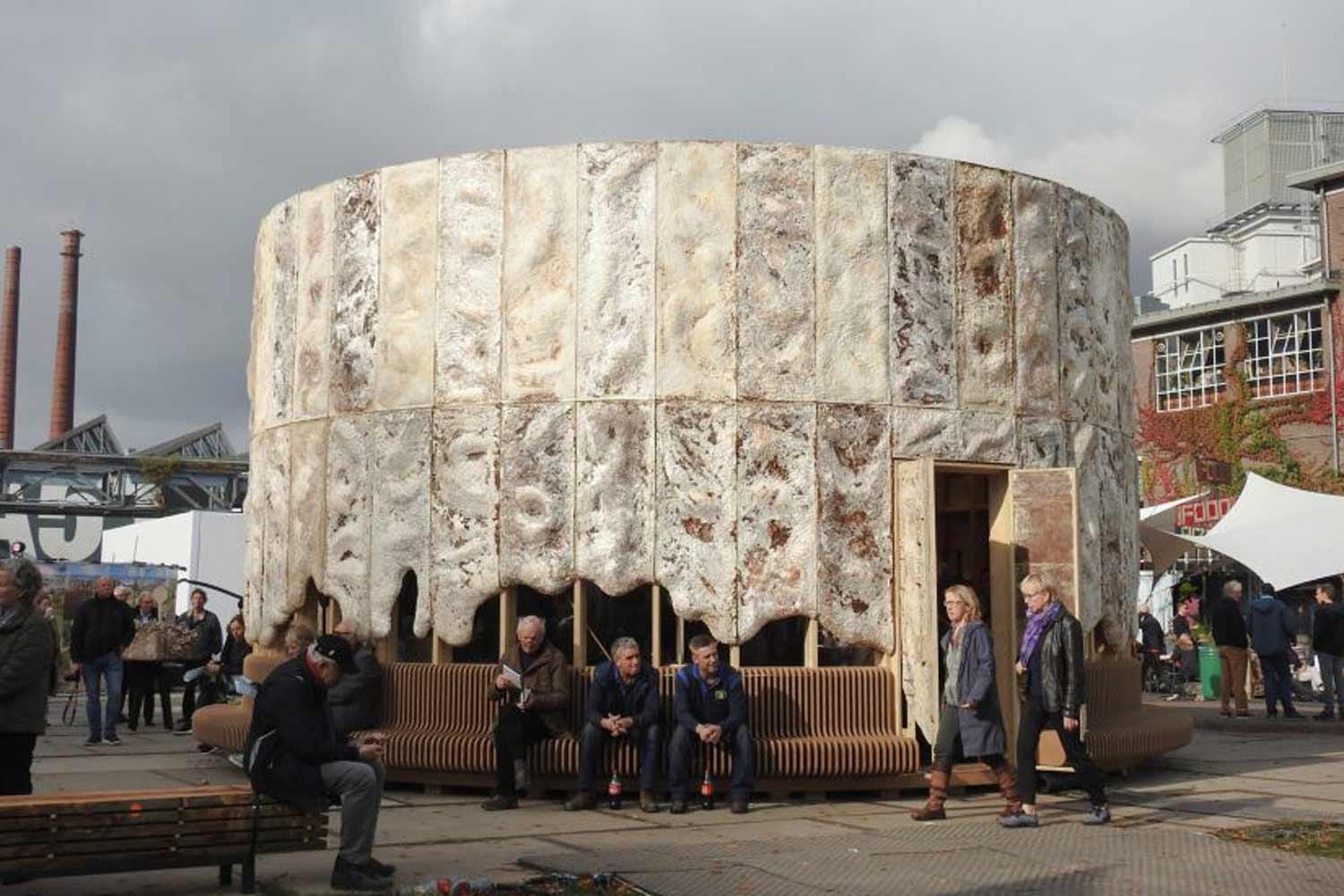
The rise in R&D investment—seen in companies like Ecovative Design and research institutions such as the University of Nottingham actively exploring new applications for mycelium in construction—along with expanding commercial uses in packaging, interiors, and modular building, and the emergence of intellectual property frameworks, all signal its growing industrial relevance. Importantly, mycelium’s appeal now extends beyond niche sustainability circles, as it gains recognition for its performance, aesthetics, and potential to drive innovation across sectors.
IV. Driving Widespread Adoption: Branding, Corporate Action & Policy
To move mycelium from alternative to expected, we must do more than showcase its technical capabilities—we must shift the cultural narrative. Communication is the bridge between innovation and adoption. Think of Patagonia’s now-iconic “Don’t Buy This Jacket” campaign: provocative, value-driven, and highly effective in reframing consumer behaviour. In a similar spirit, how we present mycelium—whether as a symbol of nature’s intelligence, a design revolution, or a bridge between past and future—shapes its social acceptance and desirability.
As highlighted in a recent RIBA webinar on sustainability in architecture, understanding a material’s full life cycle assessment (LCA) is fundamental. Without this, even the best intentions can drift into greenwashing.
Great storytelling humanises new materials. It links them to values people already hold dear—beauty, wellness, legacy, and resilience. Through exhibitions, urban installations, immersive media, and emotionally intelligent branding, we can help audiences not only understand mycelium, but feel something for it. Sustainability must move hearts as well as minds.
This communication, however, must be grounded in evidence. For example, bamboo is often praised as a sustainable material, yet a bamboo straw can have a higher operational carbon footprint—up to 40 grams—than its plastic counterpart. Messaging must reflect this complexity, guided by data rather than assumptions. LCA tools are essential for crafting transparency and trust.
At the same time, policy plays a crucial role in scaffolding innovation. Regulations that mandate LCAs, restrict misleading environmental claims, and incentivise low-impact materials can help level the playing field. A hybrid policy approach—balancing encouragement with enforceable standards—can create fertile ground for new materials like mycelium to thrive.
V. Inclusive by Design: Ensuring Equitable Access
The future of sustainable architecture must be inclusive by design. The promise of mycelium cannot be reserved for the privileged or confined to flagship eco-developments. Communities historically excluded from green innovation—often those most affected by climate breakdown, as mentioned earlier—must be at the centre of its deployment.
Here, mycelium’s affordability, low-tech production methods, and adaptability to local resources offer a compelling opportunity. Imagine bricks grown from agricultural waste, produced by and for local communities, used in building low-cost, healthy homes. In this model, sustainable design becomes a tool for empowerment, not just aesthetics.
Environmental justice is inseparable from social justice. Mycelium has the potential to close gaps in access to green living—if supported by inclusive policies and community-driven partnerships. A regenerative material is only truly regenerative when it benefits people as much as the planet.
VI. Speculative Futures: Communicating Regenerative Possibilities
Mycelium holds the potential not only to transform buildings but to reimagine the systems that shape how we live, collaborate, and care for one another. At its most hopeful, this living material enables a decentralised model of production—one where bio-fabrication hubs are not hidden in industrial zones but embedded within the heart of communities. In doing so, we plant the seeds for a new kind of cultural infrastructure: one that is regenerative, relational, and deeply rooted in place.
Just as traditional village economies or local craft guilds once shaped a community’s identity and cohesion, small-scale mycelium manufacturing can become a vehicle for participatory design—empowering people to adapt the material to their local climates, visual languages, and cultural needs. It’s not simply about sustainability—it’s about sovereignty. A shift from top-down development to collective authorship, where people are not passive recipients of design but active stewards of their environment.
This transformation isn't hypothetical. A compelling example comes from Seoul, South Korea, where a student-led urban regeneration project reshaped how residents and institutions co-create space. In the Student Village Design Project (Kim & Kim, 2022), university students engaged directly with local residents to co-develop urban solutions that reflected the community’s actual needs and values. Unlike conventional urban renewal efforts, which often prioritise infrastructure over inclusion, this initiative used community planning as both a design tool and a healing process—rebuilding trust, reducing conflict, and enabling shared authorship in a rapidly changing university town.
This kind of model resonates with the mycelial metaphor: networks that grow through connection, resilience that is cultivated through dialogue. When communities are invited to shape their built environments—using materials like mycelium that are adaptable, locally sourced, and environmentally sound—they aren’t just building structures. They’re cultivating belonging.
It’s a shift from passive consumption to active stewardship. A model where design is not imposed, but co-evolved. In this vision, production becomes personal—and regeneration becomes a collective, everyday practice.

VII. Navigating Challenges: Scalability, Suitability & Sustainability
Despite its promise, mycelium architecture is not without hurdles. Issues around durability, fire resistance, and cost-efficiency in extreme climates require further research and context-specific innovation. Mycelium, in its raw form, can be susceptible to moisture damage and isn't naturally fire-resistant. However, researchers are exploring various treatments and coatings to enhance its durability and fire performance, such as combining it with other natural materials like clay or applying fire-retardant coatings. Crucially, not every natural material is inherently sustainable in every context. That’s why robust life cycle assessments and regional testing must inform decisions about where, how, and when to use mycelium. The goal should be strategic deployment—not universal substitution. Sustainable doesn’t mean one-size-fits-all; it means responsive, localised, and intentional.
VIII. A Living Future: Towards a Regenerative Design Ethic
Mycelium represents more than a material innovation—it symbolises a deeper philosophical shift. It urges us to see the city not as a machine, but as an ecosystem. To view decay not as decline, but as transformation. To embrace an architecture that breathes, grows, and returns to the soil.
But realising this vision requires overcoming structural barriers. A lack of standardised testing and certification makes it difficult for biomaterials to compete with conventional ones. Regulatory frameworks often lag behind innovation, creating friction for those trying to bring these ideas to market. And old habits die hard—developers may resist due to cost concerns or unfamiliarity with the material.
Yet the momentum is building. With bold policy, thoughtful investment, inclusive design, and compelling storytelling, we can accelerate the shift toward regenerative architecture. One where buildings don’t just reduce harm—but actively contribute to ecological health.
Now is the time to support research, advocate for material transparency, and demand building practices that regenerate rather than deplete. Mycelium offers us a living blueprint—a chance to build not just better, but differently.
It’s a future worth growing, together.